 Back to all news

Mastercard is introducing a broader approach to monitoring fraud and disputes.
From 1 April 2027, the current Acquirer Chargeback Monitoring Program (ACMP) will evolve into the Global Merchant Audit Program (GMAP). The new framework will assess reported fraud – including fraud that does not result in a chargeback – together with non-fraud chargebacks.
GMAP will also introduce new monitoring categories at both merchant and acquirer level. For merchants, this means that looking at the traditional chargeback ratio alone will no longer provide a complete picture of their exposure.
Key points for merchants
- A broader Mastercard framework. From 1 April 2027, GMAP will replace ACMP in its current form and bring EFM, ECM and HECM into the new framework.
- Fraud and disputes will be viewed together. Mastercard will count reported fraud, including cases that never become chargebacks, alongside non-fraud chargebacks.
- Performance will be reviewed monthly. The combined fraud and non-fraud chargeback count will be compared with the previous month’s sales, while minimum transaction and value criteria will also apply.
- New monitoring categories will apply. HDM and EDM will assess individual merchants, while HDA and EDA will monitor acquirers at portfolio level.
- The consequences go beyond assessments. Depending on the category and duration of identification, Mastercard may notify issuers or apply additional fraud-chargeback liability.
- Returning below the limits takes time. The audit counter resets only after three consecutive months below both the relevant High and Excessive Dispute thresholds.
What is changing from ACMP to GMAP
The existing Excessive Chargeback Merchant (ECM), High Excessive Chargeback Merchant (HECM) and Excessive Fraud Merchant (EFM) programs will not disappear. They will become part of GMAP.
At the same time, Mastercard will introduce four new monitoring categories from 1 April 2027:
- High Dispute Merchant (HDM)
- Excessive Dispute Merchant (EDM)
- High Dispute Acquirer (HDA)
- Excessive Dispute Acquirer (EDA)
The first two assess individual merchants, while HDA and EDA evaluate fraud and dispute performance across an acquirer’s entire merchant portfolio.
The most important change is that Mastercard will combine two types of activity:
- Reported fraud: fraud reported to Mastercard’s Fraud & Loss Database, including fraud that does not become a chargeback.
- Non-fraud disputes: chargebacks raised for non-fraud reasons.
This gives Mastercard and acquirers a broader view of merchant performance and allows them to identify increasing risk earlier.
How Mastercard GMAP measures fraud and disputes
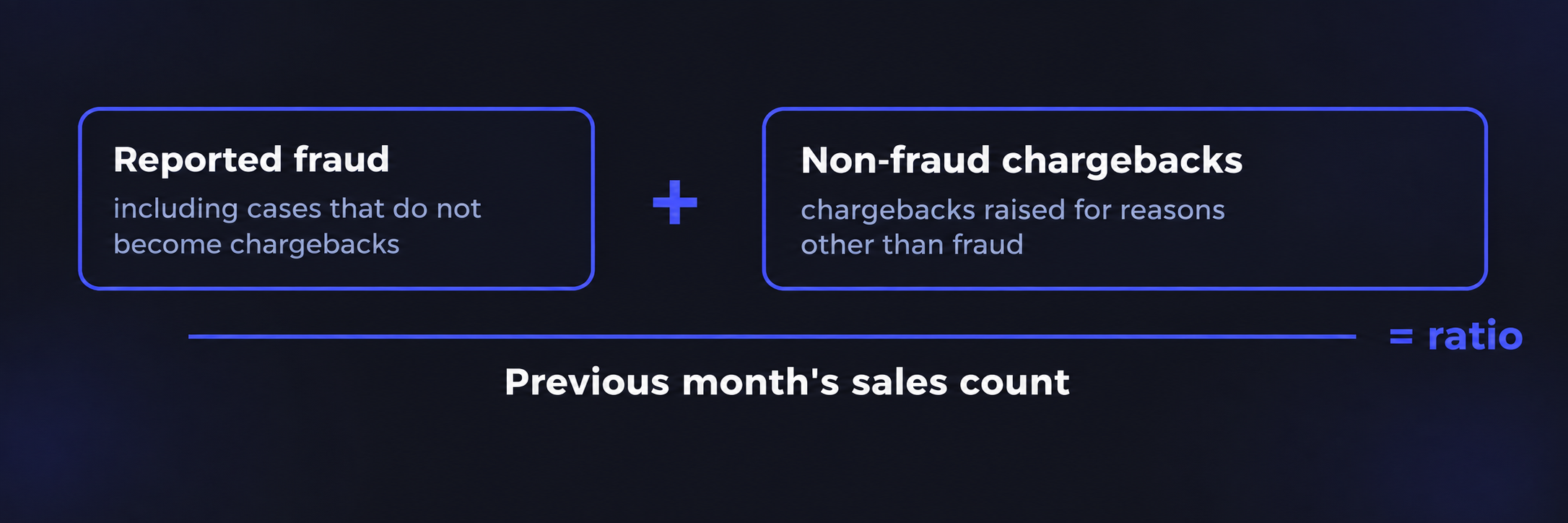
GMAP calculates the ratio by adding reported fraud and non-fraud chargebacks, then comparing the total with the number of sales from the previous month. Mastercard also checks their combined monetary value separately.
New merchant-level monitoring HDM and EDM
The two new categories most directly relevant to merchants are HDM and EDM. To be identified under either category, a merchant must meet all the stated criteria during the month.
| Category | Monthly criteria | Mastercard assessments |
| High Dispute Merchant (HDM) | At least 5 cleared transactions; at least USD 5,000 in reported fraud plus non-fraud chargebacks; and a ratio of at least 5% against the previous month’s sales. | Months 1-6: USD 0 Months 7-11: USD 5,000 Months 12-18: USD 10,000 Month 19 onward: USD 25,000 |
| Excessive Dispute Merchant (EDM) | At least 5 cleared transactions; at least USD 10,000 in reported fraud plus non-fraud chargebacks; and a ratio of at least 50% against the previous month’s sales. | Month 1: USD 5,000 Month 2: USD 25,000 Months 3-11: USD 100,000 Months 12-18: USD 200,000 Month 19 onward: USD 300,000 |
Mastercard program assessments.
How to read the thresholds
To be identified under HDM or EDM, a merchant must meet all three criteria listed in the table at the same time.
HDM elevated risk
A merchant is identified as a High Dispute Merchant when it has:
- At least 5 cleared transactions;
- At least USD 5,000 in reported fraud and non-fraud chargebacks; and
- A combined fraud and non-fraud chargeback count equal to at least 5% of the previous month’s sales count.
For example, if a merchant processed 1,000 sales in the previous month, the 5% threshold would represent 50 reported fraud transactions and non-fraud chargebacks. Their combined value must also reach at least USD 5,000.
The applicable Mastercard assessments are USD 0 in months 1-6, USD 5,000 in months 7-11, USD 10,000 in months 12-18 and USD 25,000 from month 19 onward.
EDM excessive risk
A merchant is identified as an Excessive Dispute Merchant when it has:
- At least 5 cleared transactions;
- At least USD 10,000 in reported fraud and non-fraud chargebacks; and
- A combined fraud and non-fraud chargeback count equal to at least 50% of the previous month’s sales count.
For example, if a merchant processed 1,000 sales in the previous month, the 50% threshold would represent 500 reported fraud transactions and non-fraud chargebacks. Their combined value must also reach at least USD 10,000.
Because EDM represents a much more serious level of risk, assessments begin immediately: USD 5,000 in month 1, USD 25,000 in month 2, USD 100,000 in months 3-11, USD 200,000 in months 12-18 and USD 300,000 from month 19 onward.
If a merchant exceeds the EDM threshold for two months, additional liability applies. This covers fraud-related chargebacks connected to transactions from the three months before identification, as well as fraudulent transactions occurring during the following six months.
Mastercard may also allow issuers to use chargeback reason code 4849 to recover 100% of the relevant transaction amount.
What happens to the existing ECM program
The existing Excessive Chargeback Merchant program will remain in place as part of GMAP.
For 2027 and 2028, its criteria will remain unchanged at 100 or more chargebacks and a chargeback ratio between 1.50% and 2.99%.
Mastercard plans to lower the ratio threshold gradually starting 2029 , reaching 0.90% in 2031. Merchants already operating close to the current 1.50% threshold should therefore continue monitoring their chargeback performance carefully.
What merchants should do before April 2027
- Check your current performance. Work with your acquirer or payment provider to review reported Mastercard fraud and non-fraud chargebacks against the new HDM and EDM thresholds.
- Look beyond your traditional chargeback ratio. Fraud reported by issuers can contribute to GMAP monitoring even if it does not result in a chargeback.
- Identify recurring problems. Review issues such as unclear billing descriptors, difficult cancellations, delayed refunds, recurring billing complaints, fulfilment problems and insufficient customer support.
- Set internal warning levels. Monitor fraud and disputes below the official Mastercard thresholds so that you have time to investigate and correct problems before they escalate.
- Work with your acquirer. Early communication can help identify the cause of deteriorating performance and establish the appropriate corrective measures.
The key takeaway
GMAP expands Mastercard’s monitoring beyond traditional chargeback performance. From April 2027, reported fraud and non-fraud disputes will be assessed together at both merchant and acquirer level.
For merchants, the main priority is to understand their complete fraud and dispute performance rather than relying on the chargeback ratio alone. Businesses that identify recurring problems and act before the official thresholds are reached will be better positioned under the new framework.
Source
Mastercard, GLB 14127.1, Revised Standards for the Acquirer Chargeback Monitoring Program (ACMP), the Global Merchant Audit Program (GMAP), and the Questionable Merchant Audit Program (QMAP), published 28 July 2026.
