 Back to all news

The rise of European schemes
David Rintel, CEO, finby
The European e-commerce payments market is becoming increasingly fragmented, as domestic payment schemes continue to challenge the long-standing dominance of Visa and Mastercard. Across a growing number of countries, local solutions are gaining scale, changing consumer expectations and reshaping how merchants need to think about payments.
Key points:
Local schemes are gaining strength:
In at least 12 European markets, international card schemes are no longer the dominant online payment method. Instead, domestic solutions such as Blik in Poland, iDeal in the Netherlands, Bancontact in Belgium, and Bizum in Spain are winning share through strong local adoption and seamless customer experiences.
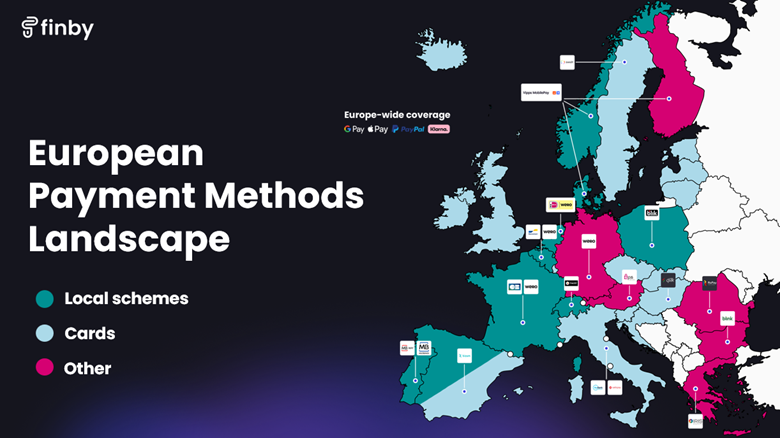
Why these methods succeed:
The most successful local payment methods share several advantages. They eliminate manual entry of card details, reduce merchants’ PCI burden, and are often embedded directly into banking apps or enabled through QR codes or simple authorization flows. They also tend to be cheaper for merchants than cards and usually provide guaranteed payments.
Limits of domestic champions:
While many local schemes are highly successful in their home markets, they often struggle to expand cross-border. These schemes are typically built as four-party models, with strong support from local retail banks in their domestic markets and usually include an interchange structure that helps sustain issuer participation.
Wero and the pan-European ambition:
Wero is the latest attempt to build a unified European payment scheme. With backing from major banks and the benefit of building on acquired brands such as iDeal and Payconiq, it enters the market with stronger foundations than earlier initiatives. At the same time, it faces serious obstacles, including competition from cards, wallets, and other strong local players.
What comes next:
Rather than consolidation, Europe is likely to see even more payment fragmentation in the near future. New account-to-account schemes are emerging, interoperability remains uncertain, and domestic champions continue to grow.
The direction is clear: businesses operating in European e-commerce must be ready to adapt to a fast-changing payments environment. Flexibility, local relevance, and the ability to respond to constant change will be critical for long-term success.
